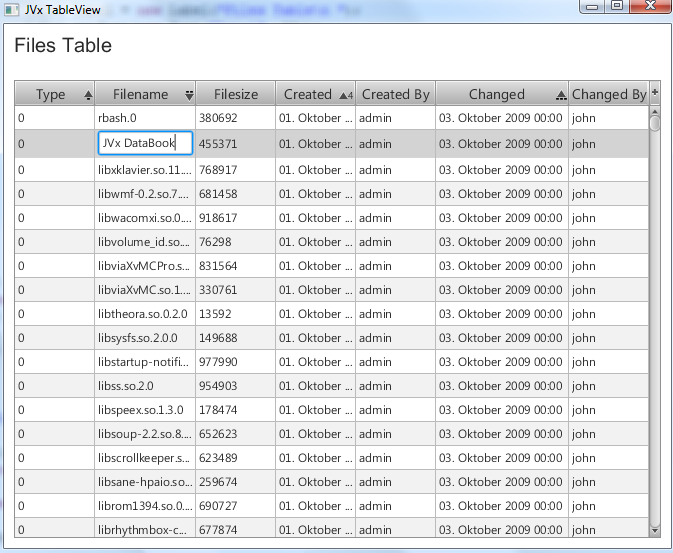
First Application example update to JVx 1.0
The new version of our first application - 1.2 - includes JVx 1.0.
We replaced the old JVx version with the new one and used the APIs.
The new version of our first application - 1.2 - includes JVx 1.0.
We replaced the old JVx version with the new one and used the APIs.
Our Showcase application is up-to-date! We have updated all libraries to the latest versions.
The source files are available here.
Test the new REST interface:
List of Contacts
List of Educations
Use admin as username and password.
JVx 1.0 is out and we have some Source Code statistics for you!
Our last statistics were determined for JVx 0.8. It is cool to compare 0.8 with 1.0. We have again worked very efficiently because 1.0 contains approximately 420 Features and Changes compared to 0.8. The Source Code grew by 18.767 lines, since 0.8. That means, we need 44 Code lines for one feature
Here are the numbers:
| JVx library | Swing UI | |||||||||||||||||||||||||||||||
|
|
|||||||||||||||||||||||||||||||
| JVx library (Test cases) | ||||||||||||||||||||||||||||||||
|
||||||||||||||||||||||||||||||||
Hm... we thought that we reach 100.000 LoC with JVx 1.0, but we "only" have 97.454. Compared to the features of JVx, we have still too few lines of code. Maybe we should use a code generator or Object Mapper or simply integrate a bunch of new features?
Some additional numbers:
| Files and Tests | ||||||||||||
|
||||||||||||
| Absolutely fine! Very easy to maintain. | ||||||||||||
|
||||||||||||
The test result is not perfect but we are happy with it. We should nevertheless pay more attention to the test coverage... and we still need a solution for automatic UI tests.
We proudly present JVx 1.0!
What a year... The first release of VisionX is out, and we finished our work on JVx 1.0.
This release is awesome. It contains a total of 230 changes to 0.9.
We implemented really cool productivity features, some fancy UI features and we fixed some bugs. But the complete list is really long
Our original Roadmap for 1.0 had fewer Features, but thanks to the community, JVx 1.0 now contains a lot of wonderful things.
In the following weeks we plan to write more documentation especially about the new features and update our showcase and demo apps. It is not possible to write about everything in this posting - and it is also Christmas. One of the next postings will be some statistics about the JVx source code - LoC, quality, ...
We think it is also time for more WebUI... maybe another implementation... let's see. And of course, mobile devices are still very interesting. We started first attempts with Android some months ago. We made some POCs with Pivot and JavaFx 2.0 and who knows what the next year brings.
And we have still a lot of new ideas to speed-up the development time. Without JVx 1.0 you develop as fast as possible - but with JVx 1.0 you develop with the speed of light.
Now, a very short look at JVx 1.0
You find the complete list in the Changelog.
And last but not least, we look forward to your feedback!
Some of you asked us: When is JVx 1.0 available?
The answer was and is still: This year ![]()
More precisely: Planned release date is Friday, 23rd December.
The current version in our SVN repository is Feature complete. Only some tickets are still open, but all of them are not really important for 1.0. Some are beautifying and some are smaller bugs that do not hurt.
We are optimistic that these are done till Friday, otherwise the open tickets will be moved to Release 1.1.
In addition to numerous changes and new features, the REST support is certainly one of the most interesting innovation. The feature was not originally planned for 1.0, but it is cool nowadays.
But what do we understand as "REST support"?
Every server-side action, and every object that is available via a Life-Cycle object, are accessible via REST calls. Don't worry about security, because the same access checks are done as for common applications. If an action or object is available for an application, it is available via REST calls.
You don't need additional configurations for your applications, actions or objects - no annotations and no config files are needed.
It sounds simple? Yes, it is so simple!
I want to show you a short example, based on Restlet. We have a life-cycle object like the following:
dbs.setDBAccess(getDBAccess());
dbs.setWritebackTable("ADDRESS");
dbs.open();
put("address", dbs);
}
return dbs;
}
public String getData()
{
return "Text data";
}
}
The object has one action "getData" and the object "address".
Now we call the action:
ClientResource cres = new ClientResource(sHost);
Representation rep = cres.get();
String sData = JSONUtil.getObject(rep, String.class);
And we fetch all records:
ClientResource cres = new ClientResource(sHost);
Representation rep = cres.get();
List liRecords = JSONUtil.getObject(rep, List.class);
Is it as simple as expected? We hope so
Of course, there are options for fetching only specific records. Insert new records, update and delete one or more records. All options are implemented in test cases. Have a look at the Action or Storage tests.
More details and the documentation will follow after the release of JVx 1.0.
With VisionX, we make it possible to create business applications without developer skills. We are often asked, how that is possible.
Our answer is always the same - keep things simple and use a language that a user understands.
Most things in VisionX are done with wizards, because it is the easiest way to give the user an overview.
We want to show you some impressions:
| Manage your users
Create new users, edit existing users, You don't need an administrator to |
| Create your own actions
Show a report on button click, Define your own processes - without developer |
| Create custom reports
You need a list of all orders, customers or Create a standard report, change and use it. Don't learn how to use a new reporting tool, use your existing office solution! |
The current version of VisionX is available as Public Cloud version. After a short registration you get access to VisionX.
The Public version shares all available applications with all registered users. It is different to the Beta phase because the Beta version was like a private Cloud per user.
With VisionX you get a tool to create your own applications without developer skills. A dream comes true.
It is no exaggeration to say that VisionX is the world's only tool of its kind.
What features are available in VisionX Cloud?
Here are some of them:
Are you interested? Start with VisionX - now.
It is available from the project page.
What’s different?
We fixed some important bugs and implemented new security checks. The new release does not have new killer features and it is more of a stabilization release. We think that the "Christkind" or maybe Santa Claus will have JVx 1.0 GA in the bag.
The MasterSession did not have a special security check for accessing the life-cycle object. If the security manager checked the login credentials as valid, it was possible to access the life-cycle object for the Master Session. The problem was that is is possible to set the life-cycle name via API, before you open the connection. It is always possible to open a MasterSession with the life-cycle object of a SubSession. But if the used security manager (e.g. DBSecurityManager) has custom access rules and does not allow the access to specific SubSessions, we had a vulnerability.
Now the MasterSession checks the access with the security manager, in the same manner as the SubSession. The ISecurityManager interface got new methods for the access checks. The DBSecurityManger contains a reference implementation.
The Utility classes are very important for JVx, because there is power inside. We tweaked existing and added new useful methods. The external program execution works now platform independent. The FileViewer now supports Linux, MacOSX and Windows.
Check the Changelog for a complete list, and use our Forum to talk with us
It is available from the project page.
What’s different?
We fixed some smaller bugs and improved metadata caching. A very cool NEW feature is the block fetching for RemoteDataBooks.
We have a metadata cache on the server side to reduce database calls and we have a cache role on the client-side to reduce remote calls. But it was not possible to change the cache role for specific connections. If the cache was enabled, it was enabled for the whole application.
Now it is possible to set a connection property to change the cache handling for all databooks which use the connection.
Off means no metadata on client-side and reload metadata from database on server-side.
On means always use the metadata cache and ignore the default setting.
Default means that the connection uses the client cache role setting.
This is an amazing new feature and boosts an application!
Before beta-4, every Master/Detail selection change executed a remote call if the detail was not already fetched. It depends on the number of detail databooks, but if you have one master and 5 detail databooks, every master-change executes 5 remote calls to retrieve detail data. 5 requests is not very clever because it should be possible in only 1 request? With 1.0 beta-4 this optimization is implemented, but not used per default. It depends on th number of records and number of details if it is possible to fetch all defail databooks as one block. It is your decision if it makes sense to use block fetching!
Be careful, the block fetch columns are not the same as used for the master reference definition!
Example:
//Block fetching does not need PARENT information, because we want all PARENTs
rdbWorkScreenMembers.setBlockFetchColumnNames(new String[] {"APPL_ID",
"CLASSNAME"});
If you use the jnlp_href tag for your applet, it is now possible to use the clipboard, file open and file save JNLP services without additional coding effort. Since 1.6 u24 it is not possible to copy/paste to/from text components. We made it possible in the Swing UI and now it is available for all your applications.
We moved IDataBook.searchNext to IDataPage and added searchPrevious to the API.
Check the Changelog for a complete list, and use our Forum to talk with us